Is a ladder allowed for a short job?
It may be, if the contractor's assessment finds it suitable for the risk and task. HSE explicitly says short duration alone is not the deciding factor.
Choosing access
The contractor planning work at height should assess the risk and choose equipment that fits the task, ground, people, materials and programme. These questions help you give them a useful brief.
Start with the task
Tell the contractor what must be reached, what they will do there, how often they need access and which people, trades or materials will use it. A brief look at one point and repeated work along an elevation put different demands on the access plan.
Show slopes, soft ground, steps, entrances, overhead obstacles, public paths and possible equipment routes. Ask whether any part can be done from the ground. HSE's work-at-height guide starts by considering whether work at height can be avoided, then how falls can be prevented.
What task is being assessed? Where must workers stand and move? What ground constraints exist? How will falls be prevented? Let the contractor assess the answers.
One option
Ladders and stepladders are not banned. HSE's ladder guidance says they can be used when an assessment shows that equipment offering more fall protection is not justified because of low risk and short duration, or because of existing workplace features that cannot be altered. Short duration alone does not decide the question; risk must be considered first.
Ask whether the ladder can be stable, the worker competent, and the surrounding area managed. Carrying materials, needing both hands for a task, reaching sideways or repeatedly changing position are details to raise in that assessment. Avoid choosing a ladder solely because the job looks quick from the ground.
Another option
A tower scaffold can provide a working platform for a task, but its suitability depends on the work and the site. HSE tower guidance says towers must be suitable for the work and erected and dismantled by trained, competent people; users should also be trained in the relevant dangers and precautions. The supporting ground needs to be firm and level. A competent person must inspect a tower after assembly and at suitable intervals.
Tell the contractor if the work is spread across several positions, an entrance has to stay open, or ground levels change along the route. Do not assume a movable tower can simply be shifted anywhere the work goes. The contractor should assess where it can stand and how each work face is reached. Leave assembly and changes to competent people.
General access
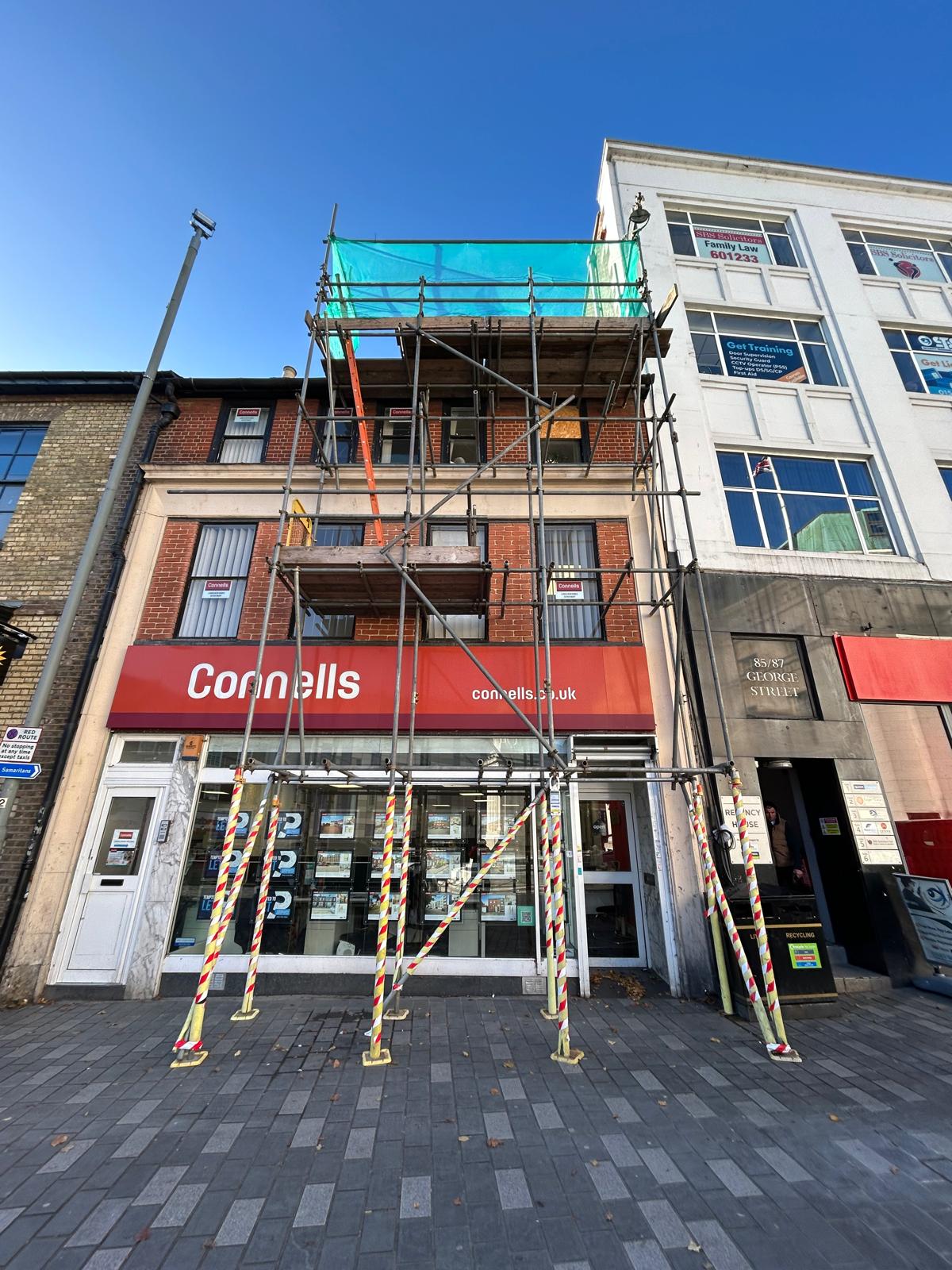
For work across several elevations or stages, ask whether a planned general access scaffold would better serve the contractor's sequence. It can be designed around the intended working areas and the loads involved, with access for the people using it. HSE scaffold guidance calls for the site, intended use, duration, working loads, access and restrictions to be supplied during planning. The provider then assesses the proposed structure and its safe use.
A scaffold still needs planning for ground support, entrances, boundaries and public routes. Equipment names alone do not settle the safest choice. Ask the trade managing the work to explain its choice and coordinate with the scaffold provider where a scaffold is proposed. If it may stand on or over a public route, read the permissions guide.
Common questions
It may be, if the contractor's assessment finds it suitable for the risk and task. HSE explicitly says short duration alone is not the deciding factor.
That depends on the work areas, ground, people and sequence. Ask the contractor to assess each work face. A tower's ability to move does not make it suitable everywhere.
Ask the contractor to identify what needs assessment and what is already known about the task and site. If a scaffold may be needed, share that brief with Arkley so we can discuss a proposal around the work areas and access constraints.
For project briefs, see preparing for scaffolding, quote questions and roof access. Our chimney repairs and loft conversion and extension guides show how to describe those work areas. Browse the guides hub for more.
Discuss your project
Share the task, work areas, ground and likely programme. We can discuss a scaffold proposal with the right access brief.